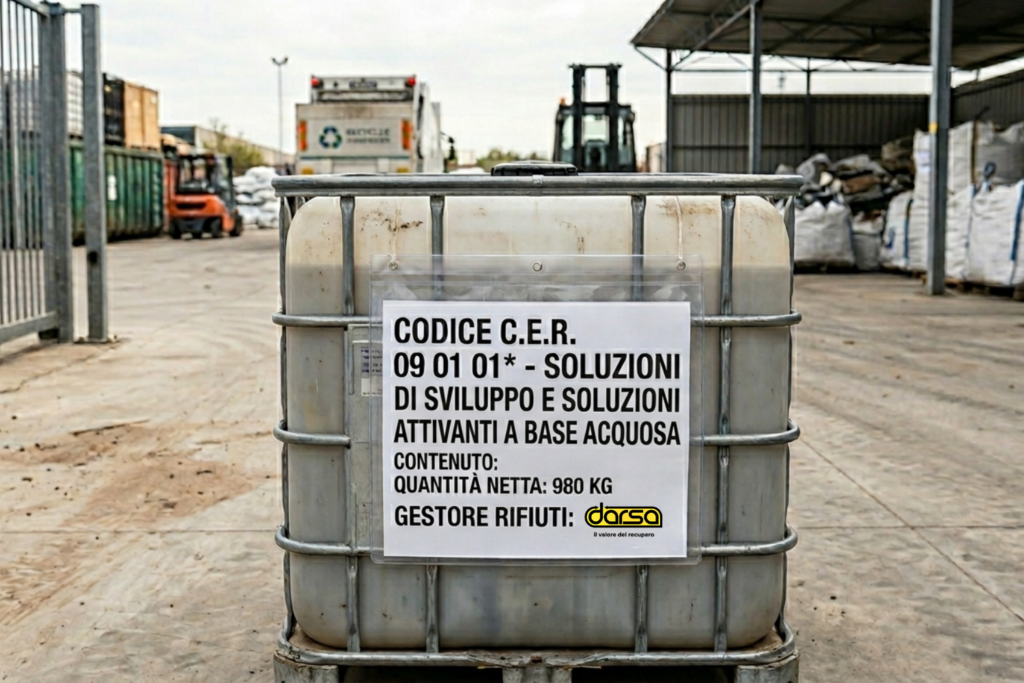
In industrial waste management, the correct assignment of the EER code-European Waste List-also known by the old wording as the EWC code-is one of the most critical bureaucratic tasks for a company. Incorrect classification exposes the business to heavy administrative and criminal penalties.
Below, in this brief guide, our Technical Managers Darsa Ltd. will explain how to correctly assign a waste identification code, in accordance with current regulations.
What is the EER code and why is it critical?
The EER code, commonly known as the EWC, is a six-digit number that uniquely identifies each type of waste at the European level. We could say it is the “identity card” of the material and determines its subsequent management, transport and disposal or valorization.
In other words, the EER code defines the origin and nature of the waste.
Assigning the correct code is entirely the responsibility of the waste producer, who must ensure the veracity of the classification, through: knowledge of the production process and, if necessary as is the case with hazardous waste, chemical analysis.
The structure of the European Waste List.
The codes are organized into 20 main classes, also called chapters, based on the field of origin. The number sequence is as follows:
- first two digits → class or chapter → identify the industry sector or activity that generated the waste, i.e., the production sector;
- second two digits → subclass or subchapter → specify the production process within that given sector, i.e., indicate the detailed process or processing that generated the scrap;
- last two digits → category → tell the exact nature of the waste, allowing identification of the specific type of waste.
The possible presence of an asterisk after the six digits indicates that the waste is classified as hazardous (ex: xx.xx.xx*)
Operational steps for EER code assignment.
As indicated by environmental regulations in order to classify a waste without error, the producer of the waste, must necessarily follow a specific order:
- Identification of waste source activity → the producer should consult chapters 01 12 or 17 to 20 to identify the activity that generated the material. If the source is clearly identifiable, the code should be chosen from within these chapters.
- Process and description analysis → once the chapter is identified, move on to the subclasses. It is essential to choose the description that best represents the physical state and composition of the material. If there is no specific entry in Chapters 01 to 12 or 17 to 20, Chapters 13,14 and 15 should be consulted.
- Use of code “99” (wastes not otherwise specified) → if no description is adequate, codes ending with the digits 99 may be used; this choice must be residual and adequately justified technically.
The problem of “Mirror Codes” and Chemical Analysis.
There are two types of codes:
- Mirror codes → these are items that describe the same type of waste, but with two variants, hazardous or non-hazardous. In this case, the producer, cannot arbitrarily choose which code to assign, it is necessary to proceed to the characterization of the waste by laboratory analysis to check whether the concentrations of hazardous substances (H1 – H15) are exceeded, according to the European regulations.
- Absolute codes → are always hazardous (marked with an asterisk, e.g., 11 01 11*) or non-hazardous.
Consequences of misclassification.
An error in assigning the EER code, formerly the ERC code, can result in:
- Environmental damage → environmental contamination capable of affecting flora and fauna.
- homeland security risks → hazardous waste handled as nonhazardous puts operators at risk;
- logistic blockage → the transporter or destination facility may reject the cargo;
- Criminal and administrative penalties → particularly in cases of improper declassification;
SOLUTION: DARSA LTD! RELY ON OUR TECHNICAL CONSULTING AND WASTE MANAGEMENT.
The complexity of environmental regulations requires a competent and specialized partner.
We, Darsa Ltd., offer a complete service for waste consulting and management, supporting companies in choosing the correct EER-CER code and in dealing with analytical laboratories.
Accurate classification, followed by consonant waste management, leads to cost optimization and reduced socio-environmental impact, initiating the recycling and urban-mining chain.
Contact us for more info, our team is at your disposal!
For more details: https://www.albonazionalegestoriambientali.it/Public/Iscrizione/CER